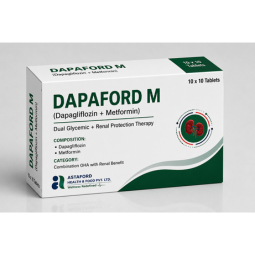
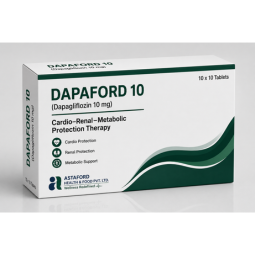
DAPAFORD 10
(Dapagliflozin 10 mg)
Cardio–Renal–Metabolic Protection Therapy
PRODUCT INTRODUCTION
Brand Name: DAPAFORD 10
Composition: Dapagliflozin 10 mg
Category: SGLT2 Inhibitor – Cardio Renal Protective Agent
CLINICAL BACKGROUND (FOR MR UNDERSTANDING)
Why SGLT2 Inhibitors in CKD & Diabetes?
In diabetic and CKD patients:
- Hyperfiltration damages glomerulus
- Increased intraglomerular pressure
- Albuminuria progression
- Cardio-renal risk rises
👉 SGLT2 inhibitors reduce hyperfiltration and protect nephrons.
MODE OF ACTION (MOA)
- Inhibits Sodium-Glucose Co-Transporter 2 (SGLT2) in proximal tubule
- Reduces glucose reabsorption
- Promotes glucosuria
- Reduces intraglomerular pressure
- Decreases albuminuria
Renal Benefit Mechanism:
✔ Restores tubuloglomerular feedback
✔ Reduces hyperfiltration
✔ Slows CKD progression
INDICATIONS
- Type 2 Diabetes Mellitus
- CKD with or without diabetes
- Heart failure (reduced EF)
- Diabetic nephropathy
- Albuminuria cases
DOSAGE
10 mg once daily
With or without food
As per physician’s advice
FEATURE – ADVANTAGE – BENEFIT (FAB)
🔹 Feature- SGLT2 inhibition
🔹 Advantage- Reduces glucose + protects kidney + cardio benefit
🔹 Benefit-Slows CKD progression & reduces hospitalization risk
USP
✔ Proven cardio-renal protective molecule
✔ Once-daily dosing
✔ Albuminuria reduction
✔ Add-on to RAAS therapy
SAFETY PROFILE
- Genital mycotic infection possible
- Mild diuresis
- Monitor renal function
- Avoid in severe dehydration