
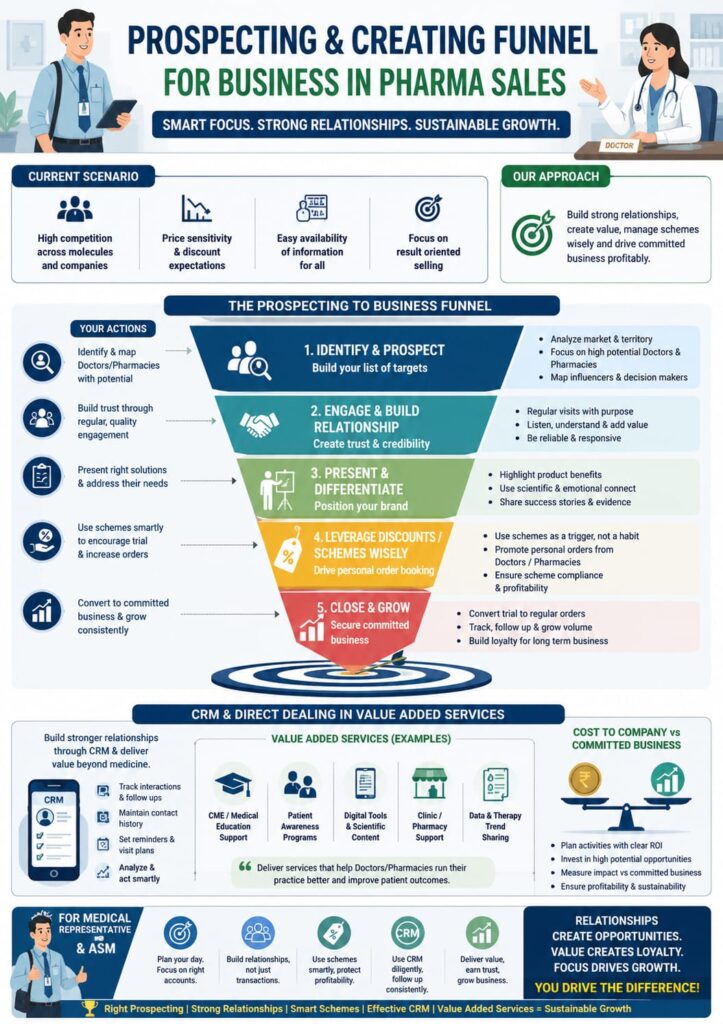
A Field Force Excellence Framework
Smart Focus. Strong Relationships. Sustainable Growth.
The pharmaceutical industry has evolved significantly over the last decade. Today, doctors have access to unlimited medical information, patients are more aware than ever, competition exists across almost every molecule, and price sensitivity has become a reality in many markets.
In such an environment, success no longer depends solely on product promotion. It depends on a field professional’s ability to identify opportunities, build meaningful relationships, create value, and convert those relationships into sustainable business.
At Renasta Lifesciences, we believe that successful pharma selling is not about making more calls—it is about making the right calls with the right purpose.
The New Reality of Pharma Sales
Today’s Medical Representative operates in a challenging environment characterized by:
Increased Competition
Multiple brands compete within the same therapeutic segment.
Price Sensitivity
Doctors, chemists, and patients increasingly evaluate value alongside efficacy.
Information Accessibility
Scientific information is available to everyone, reducing the impact of traditional detailing alone.
Outcome-Based Expectations
Healthcare professionals seek solutions that improve patient outcomes rather than merely promoting products.
This shift requires a structured and strategic approach to business development.
The Business Development Funnel
Every successful doctor, pharmacy, hospital, or institution progresses through a predictable journey before becoming a committed business partner.
The field force must manage this journey systematically.
Stage 1: Identify and Prospect
Objective:
Build a high-potential target list.
Key Activities:
- Identify potential doctors and pharmacies.
- Map specialties aligned with Renasta’s portfolio.
- Prioritize high-opportunity accounts.
- Understand local market dynamics.
- Analyze competitor activity.
Questions to Ask:
- Does the doctor see relevant patient profiles?
- Is there unmet clinical need?
- Is the product available nearby?
- Can Renasta add value?
Success Outcome:
A focused list of priority doctors and pharmacies.
Stage 2: Engage and Build Relationships
Objective:
Create trust and credibility.
In today’s market, relationships are built through consistency, reliability, and professional conduct.
Key Activities:
- Regular scientific interactions.
- Listening before presenting.
- Understanding patient challenges.
- Supporting clinical practice needs.
- Delivering commitments consistently.
Remember:
Doctors prescribe products from companies they trust.
Trust is built over multiple quality interactions—not a single visit.
Success Outcome:
Recognition and acceptance by healthcare professionals.
Stage 3: Present and Differentiate
Objective:
Position Renasta as a preferred therapeutic partner.
Focus Areas:
- Clinical benefits
- Patient outcomes
- Product quality
- Safety profile
- Economic value
- Scientific differentiation
Effective Discussion Approach:
Instead of discussing only features:
 “This product contains Iron.”
Discuss outcomes:
 “This formulation helps address CKD-associated anemia and improves hemoglobin support while enhancing patient compliance.”
Success Outcome:
Doctor interest and product trial.
Stage 4: Leverage Schemes Wisely
Objective:
Accelerate trial generation and increase adoption.
Promotional schemes should support business growth but should never become the primary reason for product selection.
Best Practices:
- Use schemes strategically.
- Promote ethical business practices.
- Ensure profitability.
- Focus on patient benefit first.
Common Mistake:
Building business entirely through discounts.
Such business rarely remains sustainable.
Success Outcome:
Increased trial generation and order conversion.
Stage 5: Close, Grow and Retain
Objective:
Convert trial into committed business.
The real success begins after the first prescription.
Key Activities:
- Follow up regularly.
- Track prescription generation.
- Monitor patient outcomes.
- Ensure product availability.
- Resolve service issues quickly.
- Build long-term partnerships.
Success Outcome:
Sustainable prescription growth and customer loyalty.
CRM: The Hidden Growth Engine
Many opportunities are lost not because of poor detailing but because of poor follow-up.
A disciplined CRM approach helps field teams:
Track:
- Doctor interactions
- Follow-up commitments
- Product interests
- Prescription trends
- Customer concerns
Benefits:
- Better planning
- Improved productivity
- Consistent follow-up
- Stronger relationships
At Renasta, CRM is not an administrative activity—it is a business growth tool.
Value-Added Services: Moving Beyond Product Promotion
Doctors increasingly value companies that contribute to patient care and professional development.
Examples of Value-Added Services
Medical Education Support
- CME programs
- Scientific discussions
- Clinical updates
Patient Awareness Programs
- CKD awareness
- Hypertension screening
- Diabetes education
Digital Scientific Content
- Educational videos
- Patient leaflets
- Digital detailing resources
Practice Support
- Clinic engagement activities
- Patient counseling support
- Disease awareness campaigns
The Result:
Stronger professional relationships and greater brand acceptance.
Opportunity Expansion: Beyond Traditional Specialties
Renasta’s portfolio allows expansion into multiple specialties.
Core Segments
- Nephrologists
- Cardiologists
- Diabetologists
- Physicians
Expansion Segments
- Oncologists
- Hemato-Oncologists
- Gynaecologists
- Intensive Care Physicians
- Palliative Care Specialists
Field teams should continuously identify new opportunities where Renasta’s products can address unmet patient needs.
Cost vs Committed Business
Every activity must contribute toward measurable business growth.
Before investing time and resources, ask:
- Will this activity improve prescriptions?
- Will it strengthen relationships?
- Will it improve patient outcomes?
- Is it sustainable?
Successful field professionals focus on Return on Investment (ROI), not merely activity volume.
The Formula for Sustainable Growth
Right Prospecting
Identify high-potential opportunities.
Strong Relationships
Build trust through consistency.
Scientific Differentiation
Position products through patient outcomes.
Smart Commercial Strategies
Use schemes responsibly.
Effective CRM
Track, follow up, and execute consistently.
Value-Added Services
Create meaningful engagement beyond products.
Field Force Action Plan
Every Medical Representative and Area Sales Manager should focus on:
Daily
- Plan calls effectively.
- Prioritize high-potential doctors.
- Record CRM updates.
- Follow up on pending commitments.
Weekly
- Review prescription generation.
- Identify new prospects.
- Track competitor activities.
- Improve doctor coverage quality.
Monthly
- Add new doctors to active call list.
- Review conversion rates.
- Evaluate business growth opportunities.
- Strengthen relationships with key opinion leaders.
Conclusion
The future of pharmaceutical sales belongs to professionals who can combine scientific knowledge, relationship building, business discipline, and patient-centric thinking.
At Renasta Lifesciences, our objective is not simply to generate prescriptions but to build trusted partnerships that improve patient outcomes while creating sustainable business growth.
Remember: